
Image credits:
Dilute suspension of flexiblefibers in turbulent channel flow
(D. Di Giusto, C. Marchioli)
Flyer:
Click here to download.Confirmed Keynote Speakers
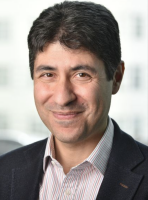
Professor Omar Matar
Imperial College London (UK)
Numerical Simulations of Complex Multiphase Flows
Abstract:
We present the results of direct numerical simulations of a variety of two- and multiphase flows of varying degree of complexity with industrial applications. Exemplars of practically important problems examined include mixing in stirred vessels and static mixers, and flows in micro-channels (with phase change), as well as environmental flows featuring aerosol formation via bubble bursting through interfaces in the oceans. Some of these flows are studied in the presence and absence of surfactants, which may be present either by design or as a contaminant. The dynamics are punctuated by frequent topological transitions related to the coalescence of dispersed drops or bubbles, and the breakup of threads or ligaments brought about by the flow. Furthermore, we also account for the spatio-temporal evolution of the surfactants along the interface and within the bulk; the bulk and interfacial species are fully coupled via sorptive fluxes. The surfactant dynamics are also coupled to the flow through the dependence of the interfacial tension on the local interfacial surfactant concentration. We also use a Large Eddy Simulation approach to account for the turbulence in the continuous phase as appropriate. For all the flows considered, we identify the various physical mechanisms present and highlight their influence on the observed fluid dynamical phenomena.
Brief Bio:
Omar Matar (OKM), FREng, FAPS, FIChemE, is a Professor of Fluid Mechanics, current Head of Department of Chemical Engineering, and Dean (Elect) of Engineering at Imperial College London. His research interests include the use of multi-scale, physics-informed, data-driven methods for the solution of complex non-isothermal multiphase flows with phase change. He has co-authored close to 400 refereed papers (16000+ citations and H-index 69) and given over 80 invited talks. He is on the editorial boards of International Journal of Multiphase Flows, Droplet, and Data-Centric Engineering.
Imperial College London (UK)
Numerical Simulations of Complex Multiphase Flows
Abstract:
We present the results of direct numerical simulations of a variety of two- and multiphase flows of varying degree of complexity with industrial applications. Exemplars of practically important problems examined include mixing in stirred vessels and static mixers, and flows in micro-channels (with phase change), as well as environmental flows featuring aerosol formation via bubble bursting through interfaces in the oceans. Some of these flows are studied in the presence and absence of surfactants, which may be present either by design or as a contaminant. The dynamics are punctuated by frequent topological transitions related to the coalescence of dispersed drops or bubbles, and the breakup of threads or ligaments brought about by the flow. Furthermore, we also account for the spatio-temporal evolution of the surfactants along the interface and within the bulk; the bulk and interfacial species are fully coupled via sorptive fluxes. The surfactant dynamics are also coupled to the flow through the dependence of the interfacial tension on the local interfacial surfactant concentration. We also use a Large Eddy Simulation approach to account for the turbulence in the continuous phase as appropriate. For all the flows considered, we identify the various physical mechanisms present and highlight their influence on the observed fluid dynamical phenomena.
Brief Bio:
Omar Matar (OKM), FREng, FAPS, FIChemE, is a Professor of Fluid Mechanics, current Head of Department of Chemical Engineering, and Dean (Elect) of Engineering at Imperial College London. His research interests include the use of multi-scale, physics-informed, data-driven methods for the solution of complex non-isothermal multiphase flows with phase change. He has co-authored close to 400 refereed papers (16000+ citations and H-index 69) and given over 80 invited talks. He is on the editorial boards of International Journal of Multiphase Flows, Droplet, and Data-Centric Engineering.