Image credits:
Dilute suspension of flexiblefibers in turbulent channel flow
(D. Di Giusto, C. Marchioli)
Flyer:
Click here to download.Confirmed Keynote Speakers
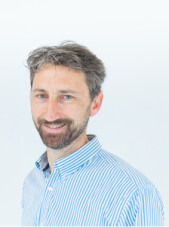
Professor Julien Chauchat
INRAE Grenoble (FRA)
From Turbulence to Ripples: A Two-Fluid Perspective on Sediment Transport
Abstract:
Sediment transport governs morphological processes in rivers, estuaries, and coastal oceans and involves complex two-phase flows with fluid-particle and particle-particle interactions across a wide range of concentrations. While turbulence dominates transport at low concentrations, it is also modulated by particles, requiring continuum approaches to capture these multiscale dynamics. In this presentation, I will show the results of recent two-fluid large eddy simulations that provide quantitative predictions of suspended load transport. Using this approach, we can also predict the interaction between turbulent dynamics, sediment transport and emerging morphological patterns in the formation and evolution of sub-orbital ripples.
Brief Bio:
Julien Chauchat is currently a senior researcher (Directeur de recherche) at INRAE Grenoble within the Institute for Environmental Geosciences (IGE). He previously served as an associate professor at the Ecole Nationale Supérieure de 'Energie, l'Eau et l'Environnement (ENSE3), part of Grenoble INP, from 2009 to 2025. Before joining Grenoble INP, he completed a postdoctoral fellowship at Aix-Marseille University (2008-2009). He obtained his PhD in fluid mechanics from the University of Caen Lower Normandy in 2007. He currently holds the industrial Chair of Excellence OXALIA of the Grenoble INP Foundation, in partnership with ARTELIA. From 2014 to 2021, he led the MEIGE team at the Laboratory of Industrial and Geophysical Flows (LEGI) in Grenoble. He also spent a one-year research visit (2015-2016) at the Center for Applied Coastal Research at the University of Delaware (USA). His research focuses on fine-scale sediment transport processes, ranging from fundamental physical mechanisms - such as particle-particle and particle-turbulence interactions - to applied topics including scour around hydraulic structures. His work combines laboratory experiments and fluid mechanics modeling to improve the predictive capabilities of engineering models. He has also made significant contributions to the development of sedFOAM, an open-source, next-generation sediment transport model.
INRAE Grenoble (FRA)
From Turbulence to Ripples: A Two-Fluid Perspective on Sediment Transport
Abstract:
Sediment transport governs morphological processes in rivers, estuaries, and coastal oceans and involves complex two-phase flows with fluid-particle and particle-particle interactions across a wide range of concentrations. While turbulence dominates transport at low concentrations, it is also modulated by particles, requiring continuum approaches to capture these multiscale dynamics. In this presentation, I will show the results of recent two-fluid large eddy simulations that provide quantitative predictions of suspended load transport. Using this approach, we can also predict the interaction between turbulent dynamics, sediment transport and emerging morphological patterns in the formation and evolution of sub-orbital ripples.
Brief Bio:
Julien Chauchat is currently a senior researcher (Directeur de recherche) at INRAE Grenoble within the Institute for Environmental Geosciences (IGE). He previously served as an associate professor at the Ecole Nationale Supérieure de 'Energie, l'Eau et l'Environnement (ENSE3), part of Grenoble INP, from 2009 to 2025. Before joining Grenoble INP, he completed a postdoctoral fellowship at Aix-Marseille University (2008-2009). He obtained his PhD in fluid mechanics from the University of Caen Lower Normandy in 2007. He currently holds the industrial Chair of Excellence OXALIA of the Grenoble INP Foundation, in partnership with ARTELIA. From 2014 to 2021, he led the MEIGE team at the Laboratory of Industrial and Geophysical Flows (LEGI) in Grenoble. He also spent a one-year research visit (2015-2016) at the Center for Applied Coastal Research at the University of Delaware (USA). His research focuses on fine-scale sediment transport processes, ranging from fundamental physical mechanisms - such as particle-particle and particle-turbulence interactions - to applied topics including scour around hydraulic structures. His work combines laboratory experiments and fluid mechanics modeling to improve the predictive capabilities of engineering models. He has also made significant contributions to the development of sedFOAM, an open-source, next-generation sediment transport model.